
“All seeing, I think, is painful. Every photograph is a little sting, a hurt inflicted in its subject, but even more: every glance hurts in some way, freezing and condensing what’s seen into something that it is not.”
– James Elkins
The Object & The Story
Photography is the art of listening, and creating an artistic retelling of, the story that something, someone, or some event has to tell.
I once asked my son, while we were looking at a photograph on the wall: ‘Is this just an object? Or is it something more—does its true nature depend on the framing, the context, the edit, the colour, and even on your own memory of the scene? Is it the object, or is it the story?
He didn’t have an answer. Neither do I. But the question is where we begin.
A photograph is a paradox: an objective trace of a subjective moment. This page is dedicated to exploring that tension—why we capture what we do, what it means to freeze time, and how a simple image can hold more questions than answers.
Two Views of the Same Skyline
Presented here are two photographs of the same subject, taken moments apart with the same camera and minimal processing. One was described by an AI analysis as “more realistic” for its balanced exposure and visible detail. The other was praised for its “mood” but critiqued for its “underexposed foreground.”
The choice between them is not a choice between reality and artifice. It is a choice between two different ideas of what “real” means: one of objective description, the other of subjective experience. In this selection lies the core debate of realist theory in photography—the medium can describe the world, but it cannot do so without simultaneously interpreting it.


AI summary for Image 1
Image 1 serves the object.
Its realism is forensic; its goal is to present the CN Tower, the city, and the lake as recognizable, tangible entities. This aligns with a scientific or documentary mode of realism, where the photographer’s hand is meant to be invisible. It speaks of a place: a serene, accessible, balanced urban park on a calm, overcast day. Its “realism” lies in its comprehensive detail.
AI summary for Image 2
Image 2 serves the story.
Its realism is phenomenological; it attempts to convey the experience of being there—the weight of the overcast sky, the contrast between the hard city and the soft, dark water. This aligns with an expressive or artistic mode of realism, where the photograph aims to feel authentic to human perception, not just optical. It speaks of a mood: a dramatic, imposing, perhaps somber city emerging from a dark, rocky shore. Its “realism” lies in its atmospheric tension.
What Does “Realistic” Really Mean?
What we call “realistic” is often just a set of technical choices—exposure, contrast, tonal priority—that align with a viewer’s expectation of how a scene “should” look. Image 2’s darker exposure is not “less real”; it is a different interpretation of the available light, prioritizing the silhouette of the skyline over the detail in the foliage.
There is no neutral way of seeing. Even a camera, a machine, cannot produce an image without interpretation.
• The camera’s metering system made a choice: expose for the sky (resulting in Image 2’s darker foreground) or average the scene (resulting in Image 1’s brighter, flatter look).
• Neither choice is “unedited.” Both are the result of a technological process that had to decide how to translate a wide dynamic range of light into a limited medium—a digital file.
When Processing Becomes Part of the Story
From capture to processing, each choice along the image’s life cycle rewrites the story.
Here are two versions of the same scene—Morningside, along with evaluations given by an AI analyzer: a cold, technical eye that measures pixels, not feelings.
These two photographs began as a single capture—a quiet view of the Morningside landscape. The only difference between them is how each was processed after the shutter closed. The version on the left stays close to the camera’s original record: natural tones, soft light, and an unadorned realism. The other was processed to echo the spirit of a painting with light.
But processing is only one stop on an image’s journey. Long after the shutter closes, meaning continues to be shaped by:
• Medium – A gallery wall, a phone screen, a book, a billboard. Each medium carries its own pace of looking and its own cultural weight.
• Framing – Literal framing (the mat, the moulding) signals importance; metaphorical framing (title, caption, surrounding text) guides interpretation.
• Place of Display – A museum whispers authority; a family album whispers intimacy; a public square speaks to everyone and no one.
• The Viewer’s Encounter – The viewer brings their own history, mood, and attention. The photograph is not finished until it is seen—and it is seen differently by every eye.
When a senior publicity manager at Cadillac Fairview saw the painted like version and remarked, “It looks like a Group of Seven painting,” they were adding another layer: interpreting the image through a cultural lens.
For constructivist theorists of photography, this pair shows that an image is never finished. From the moment of capture, through editing, to the contexts of display and the eyes that meet it, meaning is continually built, rewritten, and renewed.
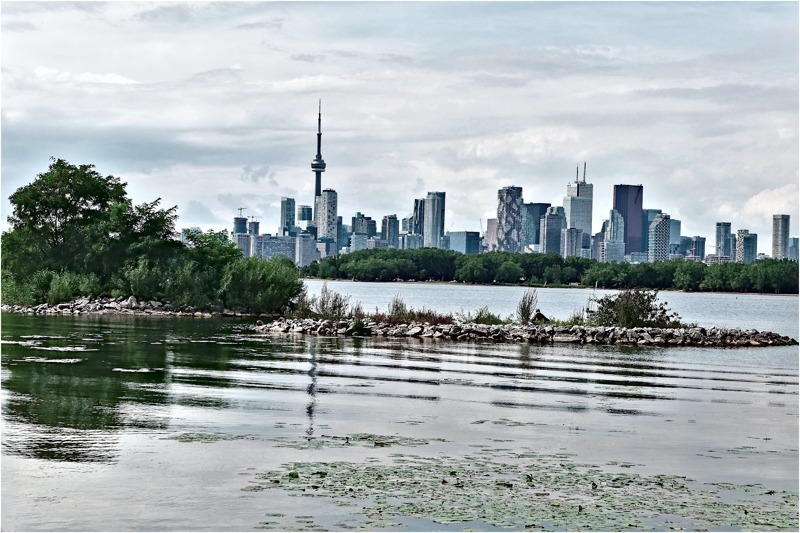
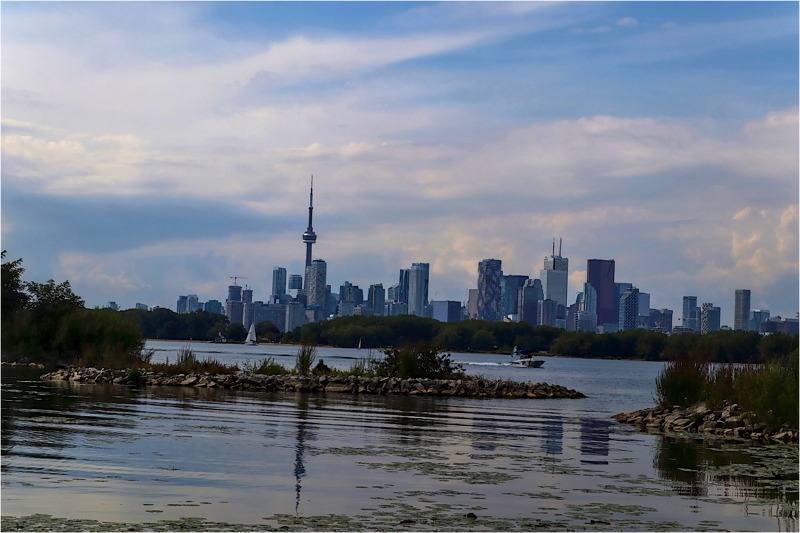
Image 1:
The colors appear natural and true-to-life, preserving the scene’s authenticity. The golden hour light enhances the warmth without looking over-processed. The water reflects the sky and landscape beautifully, creating a serene and calming effect. This is a realistic representation that evokes tranquility.
Image 2:
The vibrant colors and increased saturation make this image visually striking—bold and eye-catching. The processing gives it an artistic, painterly quality rather than a documentary one. The golden and red tones add warmth and energy, creating something that feels less like a photograph and more like a painting. It leans toward a dramatic, artistic narrative.
Same place. Same camera. Same morning light.
A friend looked at the second one and said, “That looks like a painting by the Group of Seven.” He wasn’t talking about the place anymore. He was talking about the feeling, the reference, the story the image told him.
But the machine—trained on millions of images—sees one as a document and the other as art. One records what was there. The other tells a story about it.
So Now I Ask You the Same Question I Asked My Son
Which one is the object, and which one is the story?
Or are they both objects? Are they both stories?
There’s no right answer. The question is the point. Every photograph lives somewhere on that line—between what was captured and what was created, between the thing itself and the meaning we bring to it. The camera records. But we see through layers of memory, reference, feeling, and art we’ve absorbed over a lifetime.
The next time you look at a photograph—on a wall, in a book, on your own screen—you might hear my son’s question echoing:
Is this the object? Or is it the story?
Why does one photograph feel like a document and another like a painting? The answer lies in how images are made, interpreted, and framed. The fact that you have come this far graduates you to a more interesting level in Photography Theory. Therefore, you are invited to visit the Photography Theory page.