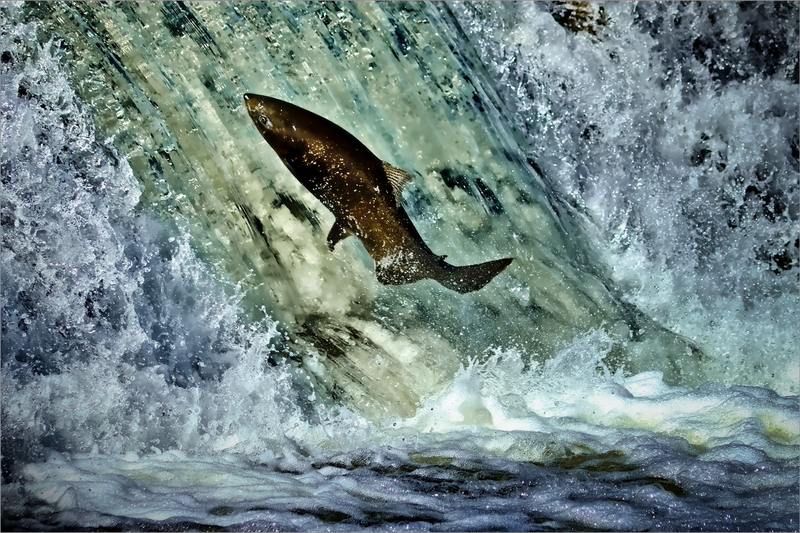
The Last Sacrifice for the Species
The water is a wall of white noise. It has been grinding against these rocks for ten thousand years, and it will not stop for him.
He is a Chinook. A king. But the kingship is a burden now, not a crown. His body, once sleek and silver, has turned dark and bronze—not a transformation, but a slow burning. The flesh is consuming itself to fuel the journey. He is running on his own ruin.
He has swum hundreds of miles from the ocean, guided by a memory he cannot explain and cannot disobey. He has not eaten. He will not eat again. His stomach has already begun to dissolve. Every leap now is funded by the last reserves of a body that is already dying.
This is the last hour. Not a metaphor. A fact.
Behind him, on the banks, are the fallen. The ones who jumped and missed. The ones who made it and then lay down in the shallows, mouths open, eyes still bright, waiting for an end that came quietly. You saw them yesterday. A war cemetery of salmon. Soldiers who fought a war they never chose, for a general—evolution—that will never know their names. He carries them in his bones.
He is not leaping for himself. He has no future to leap toward. His future is measured in hours. He is leaping for the eggs buried deep in his body, for the milt he will release over them, for the next generation that will swim out to the ocean and never know what he did here. He will die in this river. He knows it, in whatever way a fish knows anything. And still, he leaps.
The water crashes down. He launches.
For one suspended moment, he is a dark arrow against the light, a silhouette in the spray. The falls explode around him. And in that frozen second, he is not a fish. He is every soldier who ever charged a hill he would not survive. He is every parent who worked a life they would not get to enjoy. He is every creature, human or otherwise, who gave everything for something that would outlast them.
He is not a hero because he wins. He is a hero because he tries, knowing—or at least being—the cost.
The water may take him. The rocks may take him. The exhaustion may take him before he ever reaches the gravel. But this moment, this leap, this refusal to stop—this is his. No one can take it from him.
He is a father. He is a soldier. He is a ghost already. And he is, for this one impossible second, still fighting.
The river does not care. But you do. And that is the whole difference.